Regular Funds
Understanding expense ratios, intermediary commissions, and direct vs regular mutual funds
Today I Learned: I learned this today, so the information here might not be absolutely correct, although I've tried verifying as much as I could. If you find any corrections, please drop me an email!
I started my journey with Mutual Funds in 2019 and I was always exposed to Direct Funds thanks to the wonderful community /r/IndiaInvestments, tradingqna and Kuvera.
When I started discussing finances with friends, I found out about 50% of them had a portfolio similar to mine but chose to invest in regular funds because they had an advisor or those were the only funds available in the Mutual Fund platforms they were using.
So, I was curious to understand how regular funds work?
Buying a Mutual Fund
Asset Management Companies (AMC) launch Mutual Funds that can be purchased in one of two ways:
- Direct Funds: Bought by Investors directly from the AMC.
- Regular Funds: Bought by Investors through Distributors/Brokers/Advisors.
Whether you buy Direct Funds or Regular Funds - you invest in the same mutual fund.
Why Regular Funds give you a slightly lower return?
Expense Ratio is a fee investors pay to the AMC for managing their investments. It is expressed as a percentage of the Assets Under Management (AUM).
A direct fund has a lower expense ratio compared to a regular fund because the investors are cutting out the distributor/broker/advisor. When you buy a regular mutual fund, the intermediary gets a cut for the time that you’re invested, which is included in the expense ratio.
How does the intermediary earn?
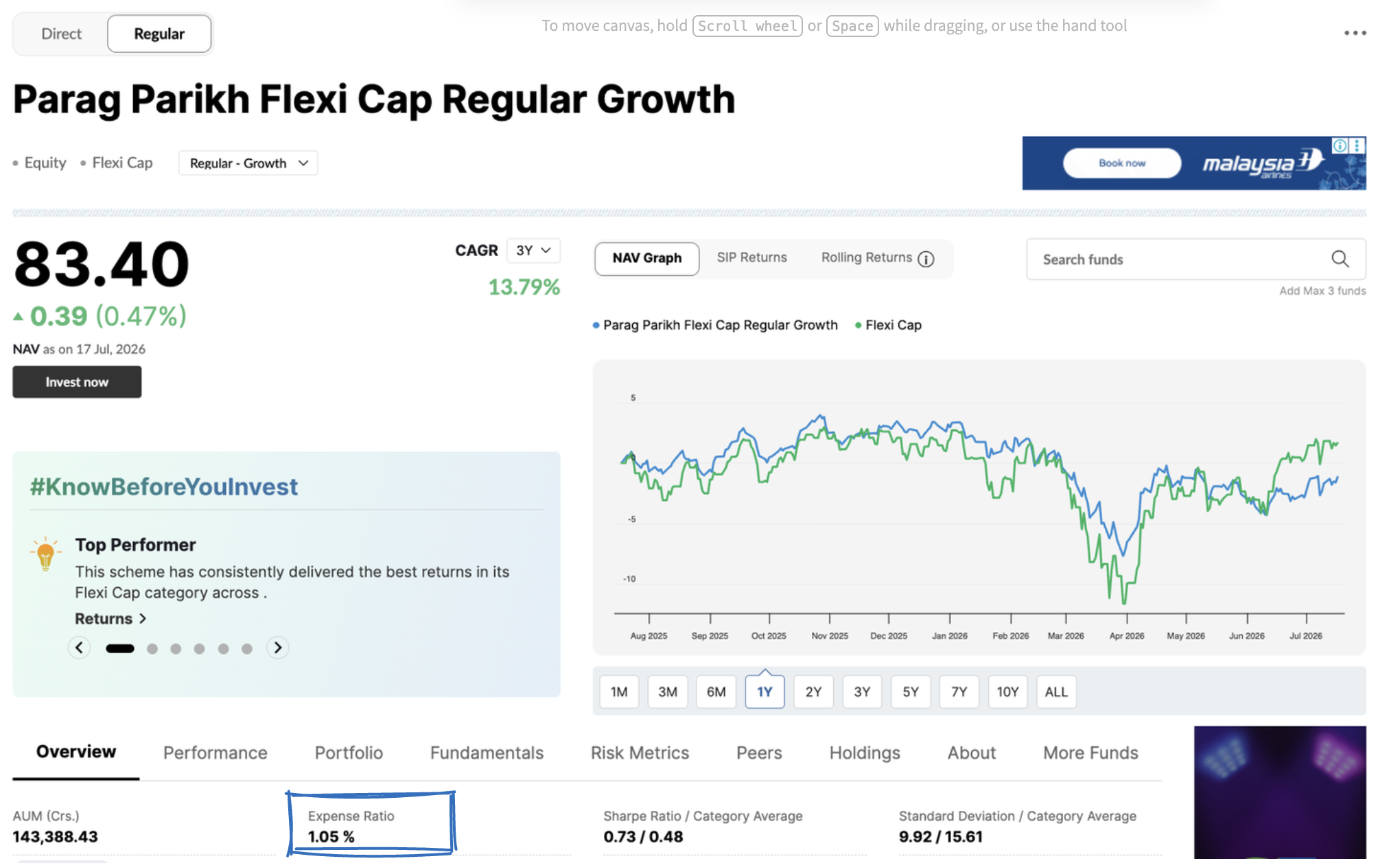
Take an example of Parag Parikh Flexi Cap Fund. The regular fund has a NAV of 83.40 with an expense ratio of 1.05%
The similar direct plan has a NAV of 91.46 with an expense ratio of 0.53%
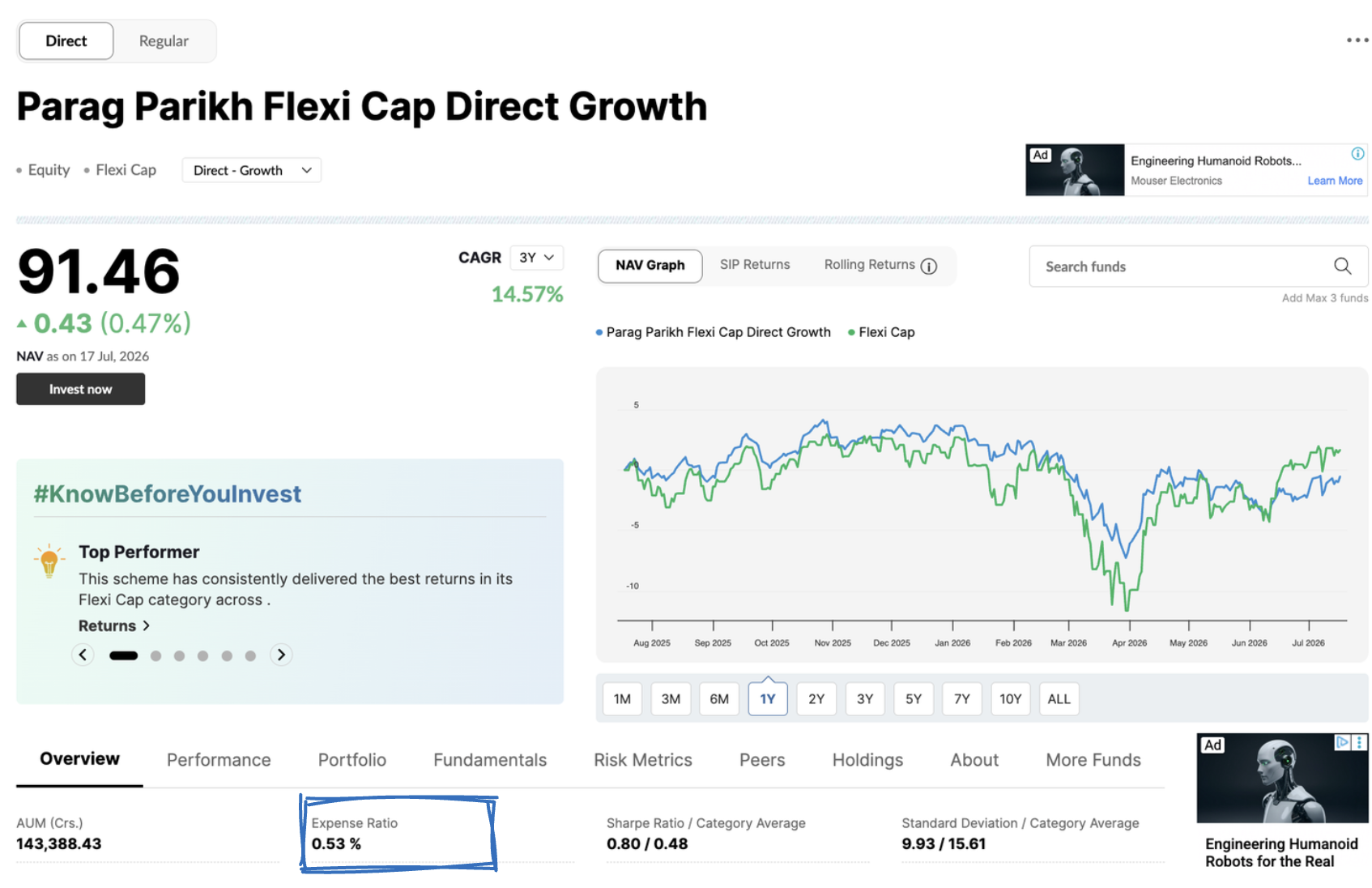
The difference in expense ratio is what the AMC uses to pay the intermediaries. The commission is annualized and calculated daily based on the formula - Difference in Expense Ratio x Your Investment Value for the Day / 365.
The intermediary hence earns as long as you are invested, even if your portfolio lost, gained or stayed the same value.
Rough Calculation
- Initial Investment (per month): 10,000
- Step Up every year: 10%
- Expected Return every year: 12%
- Difference in Expense Ratio of Direct and Regular fund: 0.52%
- Number of years invested: 20
At the end of 20 Years, you’d have:
- Total Investment: ₹68,73,000 (68.73L)
- Corpus in Regular Funds: ₹1,76,40,065 (1.76Cr)
- Corpus in Direct Funds: ₹1,86,35,965 (1.86Cr)
- Total Commissions Paid: ₹9,95,900 (9.95L)
That is ~₹83k per year that you’re paying to the intermediary for the time that you’re invested.
When does this probably make sense?
- Intermediary offers auxiliary Services like Tax Planning, Insurance, Estate Planning, etc.
- You do not have the time to research and monitor your portfolio
- You need a single platform that handles banking, trading, insurance, stocks and mutual funds and this platform only has regular funds.
What should you realistically do?
As a beginner..
If you started your investment journey recently and are investing in regular funds:
- Don’t panic sell and exit your existing investments. Plan a switch-over to direct funds
- Continue with Regular Funds if you value your intermediary’s advice and are okay with the extra comission.
As a seasoned investor..
If you are someone that has been investing for a while:
- Evaluate if the auxiliary services offered are worth the extra fee.
- Evaluate if you did get sound advice from your intermediary, which you wouldn’t have gotten otherwise
- Consider paying for a fee-only financial advisor to build a portfolio for you, if you have a sizable portfolio. Most of your mutual fund investments are long-term and should be goal-oriented, so you will not see drastic changes month-on-month.
- Read the Wiki on India Investments to understand the basics of Mutual Funds and get on a platform that sells only Direct Mutual Funds!
Resources
I got Gemini to spawn a simple calculator to demonstrate the comission outflow in Direct and Regular Funds over the years. The calculations are approximated and might not match the real-world number cent-per-cent - but it gives you an idea of the kind of money you’re paying in commissions over the years.